
Bringing history to life
The first Thuringian kingdom is the subject of many sagas and legends, which have been taken up by artists in the city. Several sculptures have been created that can be experienced on the Thuringian Legend Trail through the medieval town. The old legends can be experienced anew as playable sculptures.
Just set off and discover the medieval town in Thuringia from a completely new perspective. Have fun!
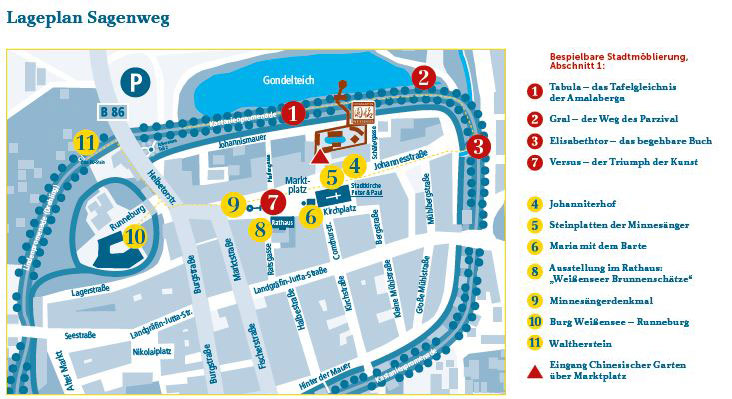
Tabula – the table parable of Amalaberga
From the brochure “Thüringer Sagenweg”. Publisher: City of Weißensee
MICHAL SCHMIDT
Material: table: reinforced concrete; well findings: polyurethane foam core laminated with synthetic resin and painted black-grey
Dimensions: table: approx. 8.0 x 2.1 m, 1.6 m high; well finds: 0.3 to 1.2 m high, Ø 0.5 to 0.9 m Weight: approx. 12 t
When the kingdom of Thuringia was divided among his three sons after the death of King Bisinius in the 6th century, Amalaberga, the niece of the Ostrogoth king Theodoric, used the metaphor of the only partially laid royal table to make it clear to her husband Herminafried that he should have sole claim to the Thuringian throne and thus insisted on the warlike dispute against his brothers Baderich and Bertachar – the beginning of the end of the Thuringian kingdom. “He who calls only half the kingdom his own may only have half the table set!”
Grail – the way of Parzival
From the brochure “Thüringer Sagenweg”. Publisher: City of Weißensee
TORSTEN IHLENFELDT
Material: Stainless steel, surrounding seat cups in natural stone Dimensions: Ø 2.5 m, length approx. 2.7 m, opening Ø 0.8 m, seat heights approx. 0.5 m Weight: 0.6 t/0.4 t
The significant reference to Weißensee comes from the term ‘Grail’. The knight and minnesinger Wolfram von Eschenbach, who was present at the court of Hermann I, Landgrave of Thuringia, gave the Thuringian region a flowering of self-confident literature with ‘Parzival’ (from the French sense of the word: Perce à Val; to cross the valley), which deals with human maturation and the meaning of life. His path, like Parzival’s and like all of our paths, is always concerned with the current question of life. Nothing remains to rest, it needs our lively development and attention in order to live.
Elisabethtor – the walk-in book
From the brochure “Thüringer Sagenweg”. Publisher: City of Weißensee
GERNOT EGWALD EHRSAM
Material: Seeberger sandstone, Corten steel Dimensions: Sandstone: 2.3 x 1.8 x 1.8 m, iron gate: 1.5 x 2.5 x 0.90 m Weight: Sandstone: 6 t, iron gate: 450 kg
Klingsor and Elisabeth (aged four) and the princely couple with Ludwig and Elisabeth as children can be seen on the front of the sandstone blocks. In this way, history can be seen and experienced. The work encourages the viewer’s perception of time periods, history, reality and legend. The work consists of the ‘walk-in book’ and the Gothic iron gate. Visitors can walk through the iron gate and the walk-in, stone book. The story of St. Elisabeth and the magician Klingsor becomes visible. Two sandstone blocks are set on two concrete foundations. The stones are dedicated to the myth and history of St. Elisabeth as a child.
Versus – the triumph of art
From the brochure “Thüringer Sagenweg”. Publisher: City of Weißensee
ERIC-ARNE SCHIECKE
Material: Seeberg sandstone Dimensions: approx. 3.0 x 3.0 m x 0.7 m high Weight: approx. 5 t
In the heyday of medieval courtly culture, minne developed into an outstanding form of cultural debate. The Thuringian Landgrave Hermann I was an important patron of the arts at this time, gathering the most renowned poets, composers, writers and philosophers of his time at his court. This patronage ultimately gave rise to one of the most important sources of today’s ethical and moral values. The sculpture Versus, carved from Seeberg sandstone, shows a larger-than-life lute above a broken sword, complemented by a game of dice. The lute is a familiar object from minnesong, its vibrations still lingering in the air. The broken sword is a symbol of weariness with war, but also a call to take a stand. Versus is thus a symbol of constant conflict and the triumph of humanity over violent self-interest.