
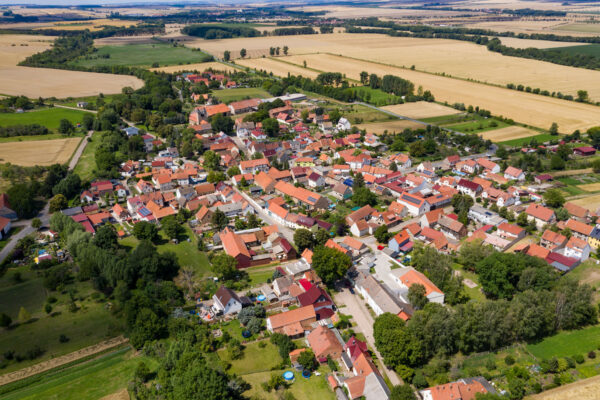
 Ottenhausen has 332 inhabitants, has been a district of Weißensee since 1994 and has retained its village character.
History
The first documented mention of the village was in 874 as “Uoteneshusa” in the Fulda tithe register. The Benedictine convent of Ottenhausen was one of the oldest in Thuringia, grew through several donations and existed until the Reformation. Parts of today’s village church, such as the Romanesque twin towers, are the former convent church. There was a manor next door on the site of the former monastery estate. It was managed by the tenant Zeller until the end of the Second World War. The farmers and estate workers from Ottenhausen who were called up for military service were replaced by Polish “foreign workers”. To the east of the village, next to the road to Weißensee, a downed US bomber plane, probably a “Flying Fortress”, exploded after hitting the ground in 1945. In April 1945, Ottenhausen was occupied by US troops without a fight and handed over to the Red Army in July. This made it part of the Soviet Occupation Zone, and from 1949 until reunification in 1990 it was part of the GDR.
Surroundings
To the south of the village, east of the Käferberg, you will find the “Wasserschlösschen” within a group of trees. It is a multi-towered miniature castle built in 1904 next to an elevated tank. This used to be a reservoir with Helbe water for Weißensee, but has been supplying the town with Ohra reservoir water for a long time and was renovated as a network distribution station in 2004.
St. Kilian Ottenhausen
The former Benedictine nunnery of Ottenhausen is one of the oldest monasteries of its kind in Thuringia. In 1116, Count Erwin von Gleichen transferred an estate to Reinhardsbrunn Monastery, from where the nunnery was presumably founded, which existed until the Reformation.
An ecclesia in Udenhusin is mentioned at the beginning of the 12th century, as well as a capella beatae Mariae virginis in 1324. Furthermore, in 1340, the Archbishop of Mainz authorized the establishment of a chapel in the village. Today’s church is based on the walls of the former monastery and consists mainly of three building elements from different eras. The oldest element is the Romanesque double tower, which was provided with coupled arched windows and belongs to the 12th century.
Scherndorf has 250 inhabitants and has been a district of Weißensee since 1993.
History
Only the few documents listed below have been preserved about the village of Scherndorf. The earliest documentary mention of the village can be found in a document from the Marburg Order Archives from 1272, according to which the inhabitants of Scherndorf were obliged to deliver 2 pounds of wax to the Herrenkapelle in Griefstedt every year. The village used to have the same relationship to the Comthurei Griefstedt as the villages of Riethgen and Waltersdorf and, like them, received foundation land on a leasehold basis for free ownership in 1852.
St. Salvator Scherndorf
There is no information about when the church chosen for the Salvator was built. It was probably built at the beginning of the 18th century and has a richly decorated pulpit altar from the time of its construction. The tower is possibly older and was crowned with a half-timbered addition in 1821.
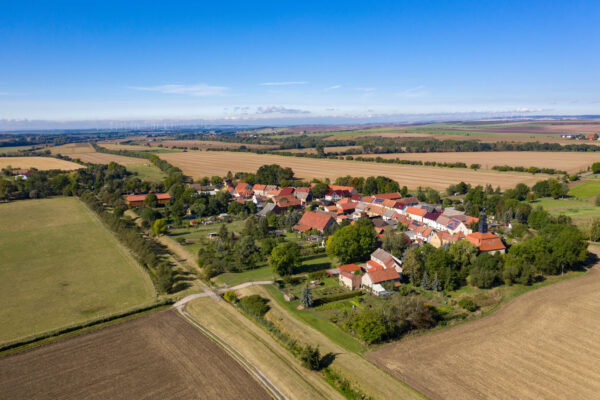 Waltersdorf lies to the east of Weißensee near the Unstrut river. The village has 121 inhabitants and has been a district of the town of Weißensee since 1993
History
The first documentary mention of the village of Waltersdorf can be found in a document from the main state archives in Weimar from 1415, in which Landgrave Frederick of Thuringia settles a dispute between the town of Weißensee and the House of the Teutonic Order in Griefstedte over shootable estates and meadow tributes between Waltersdorf and Weißensee. The village is mentioned sporadically in documents in the Magdeburg, Dresden and Erfurt archives. These mostly concerned border disputes with the owners of the neighboring Schönstedt estate. A bell house was built in Waltersdorf in 1595. In 1788, a conflagration destroyed almost the entire village. The first church visitation in Waltersdorf took place in 1540. In 1818, the rectory underwent major repairs. The village suffered greatly due to a great flood in 1830.
St. Salvator Waltersdorf
Almost nothing is known about the church’s predecessor. It was dedicated to St. Andrew and was replaced by a new building in 1711 and consecrated to St. Salvator after its completion on November 2, 1713. The patrons appear to be the commanders of the Teutonic Order’s commandery in Griefstedt, who had already held this function before. Thus, at the beginning of the 1800s, with the active participation of Commander Johann Adolph Marschall von Biberstein, an almost square central building was built, which is rarely found in our region in terms of its ground plan.
The initials of the Komtur von Biberstein and the year 1713 can be found on the stucco frame ceiling. The classicist baptismal font, which was probably created around 1837, was most likely made by the sculptor Elle from Stadtilm. A remarkably similar baptismal font can be found in Schillingstedt and also in Büchel, where the interior of the newly built church of St. Ullrich was completed by the sculptor Elle in the same year.
Two of the church bells in Waltersdorf bear the date 1788 and one the date 1763.
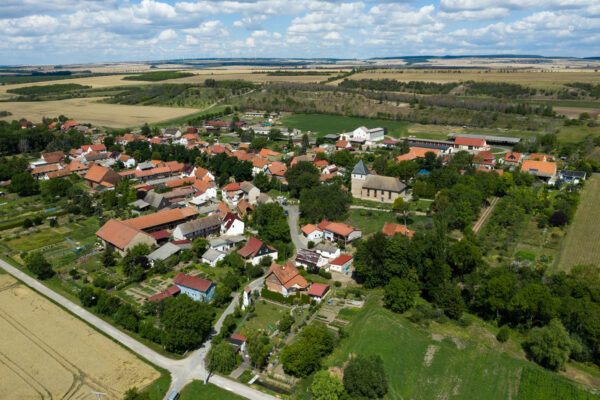 Herrnschwende is located in the Thuringian basin, northwest of Weißensee, on the Schwarzburgische Helbe, like the neighboring village of Nausiß, and has 273 inhabitants.
History of Herrnschwende
The oldest mention of the village of Herrnschwende can be found in an original document from the Schwarzburg State Archives in Sondershausen from 1253, in which Count Heinrich von Kirchberg renounces the jus advocatiae of the church at Kirchengelde in favor of Jechaburg Abbey. The seal of the parish of Herrnschwende depicts an arm holding a pair of scales with the inscription in two rings: “Discernit pondera rerum” and “Gemeinde zu Herrn-Schwende 1742”.
In addition to well-known families such as the von Greußen, von Hagke, von Reiche, von Harras and von Tennstedt, to name but a few, the monasteries of Capelle, Ottenhausen and Kölleda also received income from Herrnschwende.
1751 Friedrich August, Duke of Saxony, King of Poland, purchased the 4 former Weißenseeìschen Amtsdorfschaften Günstedt, Kutzleben, Obertopfstedt and Herrnschwende, which had been beaten to the Gangloffsömmern manor in 1747, for 86,000 Thaler. In 1760, the village was largely reduced to ashes by a great conflagration. The schoolhouse was built in 1822 and extended in 1838. In 1816 the village had 303 inhabitants in 59 houses, in 1862 it had 282 inhabitants in the same number of houses.
Until 1815, the village belonged to the Electoral Saxon district of Weißensee, but was then annexed to Prussia by a decision of the Congress of Vienna and assigned to the district of Weißensee in the administrative district of Erfurt in 1816. On 01.06.1950, the previously independent municipality of Nausiß was incorporated. Previously part of the Kindelbrück administrative community, Herrnschwende became a district of Weißensee on 01.01.2019.
The church of St. Martini
The church of St. Martini was built in 1749 and 1750 because the previous church had collapsed. The patronage belonged to the Kommende Griefstedt. In 1867, the church in Herrnschwende had 3 bells. The small bell was cast in 1783, the middle bell in 1843.
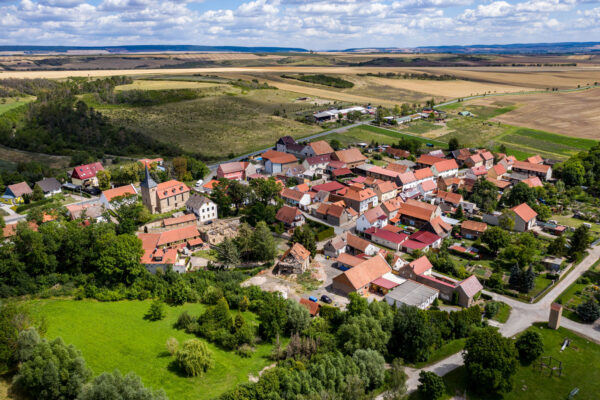
Aerial view of Nausiss