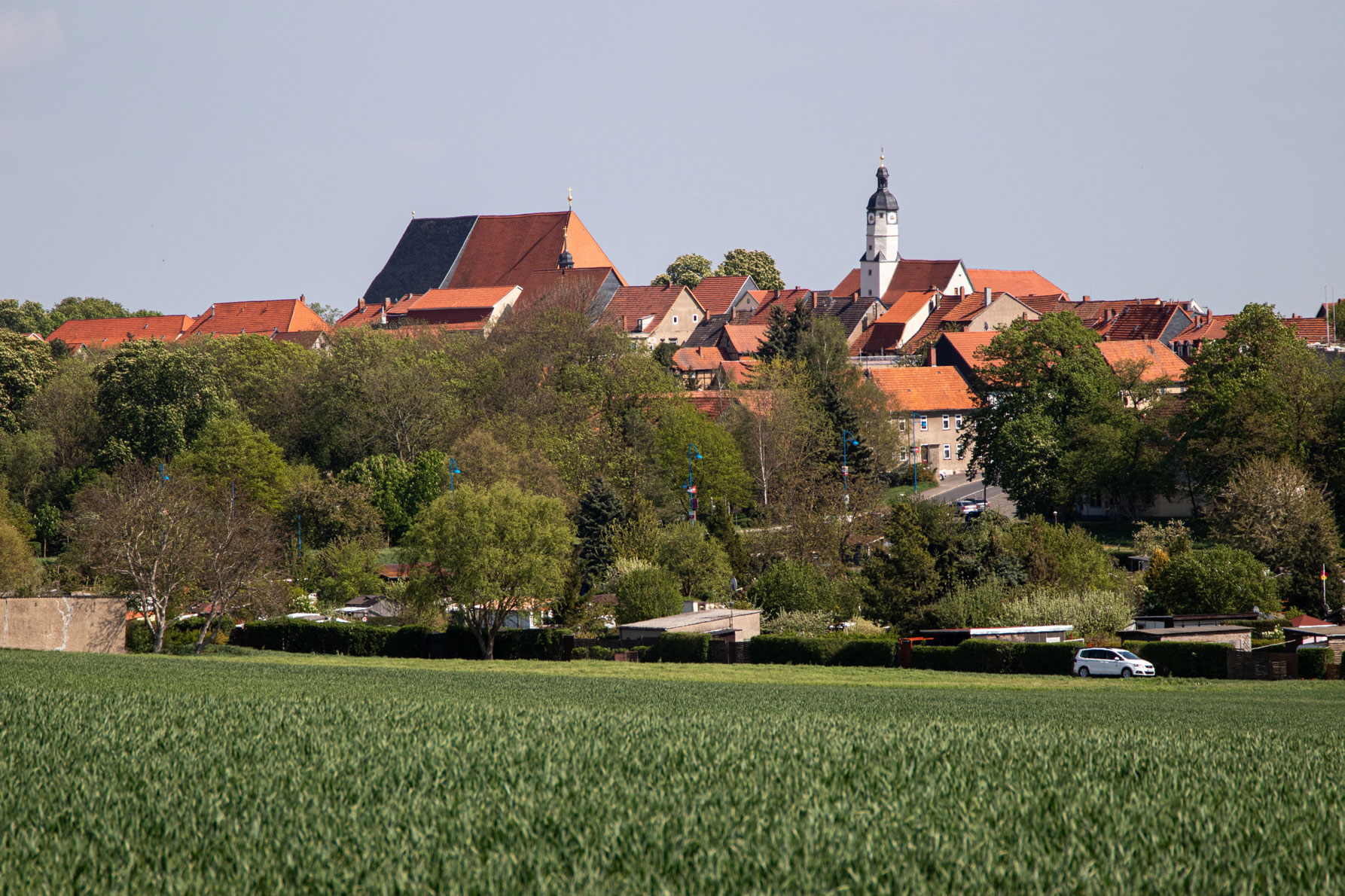
The town of Weißensee, with a population of around 3,800, is located in the district of Sömmerda and is regarded as a flourishing, growth-oriented business and tourism location in the heart of Thuringia. The incorporated villages of Ottenhausen, Scherndorf, Waltersdorf and Herrnschwende belong to the town.
City coat of arms

The coat of arms of the town shows two upright, curved silver fish in the blue field and a six-pointed star in the middle between them. The two fish symbolize the Upper and Lower White Lake. The golden star symbolizes the castle and the town of Weißensee.
The oldest known depictions of the Weissensee coat of arms can be found on bracteates from the period 1280 – 1340. The current coat of arms design has been in use since the 19th century.
City history
Weißensee has always been of particular importance, as the town was geographically located at the crossroads of the salt or copper road running from Nuremberg via Erfurt to Magdeburg and the connection between Eisenach and the Neuenburg in Freyburg an der Unstrut, which was important for the Ludovingian territory.
The town of Weißensee was founded around the year 1200 by the Ludovingian landgraves of Thuringia and is one of the most important town foundations in Thuringia in the 12. and 13th century.
The starting point for the development of the town was the enormous castle complex of the landgraves, which was soon to become the center of Ludovingian power.
Along with the castle, the first settlement with the parish church of St. Nikolai grew up on the eastern shore of the Weißer See.
The actual town was founded with the town hall and the town church of St. Peter and Paul to the east of the castle.
Mentioned in documents as early as 1174 as “wyssense”, Weißensee received its town charter on March 14, 1265.